This is the second part of my Warcraft III study for Celia Hodent’s Game UX course at IxDF. The first part looked at what made the game work for players. This one looks at what happened in their minds, and how the design could better match the way people think and learn.
Two ways of thinking
In Thinking, Fast and Slow, Daniel Kahneman describes two modes of thought. System 1 “operates automatically and quickly, with little or no effort and no sense of voluntary control.” System 2 “allocates attention to the effortful mental activities that demand it.” In a game, System 1 is the hand that moves the mouse without asking. System 2 is the player who stops to read a tooltip.
Effort has a cost. Under what Kahneman calls the “law of least effort,” people “gravitate to the least demanding course of action,” so they tend to drop tasks that make them think hard unless they have a reason that matters to them. Practice changes the balance: “As you become skilled in a task, its demand for energy diminishes.” This analysis follows that shift from System 2 to System 1.
Managing cognitive load
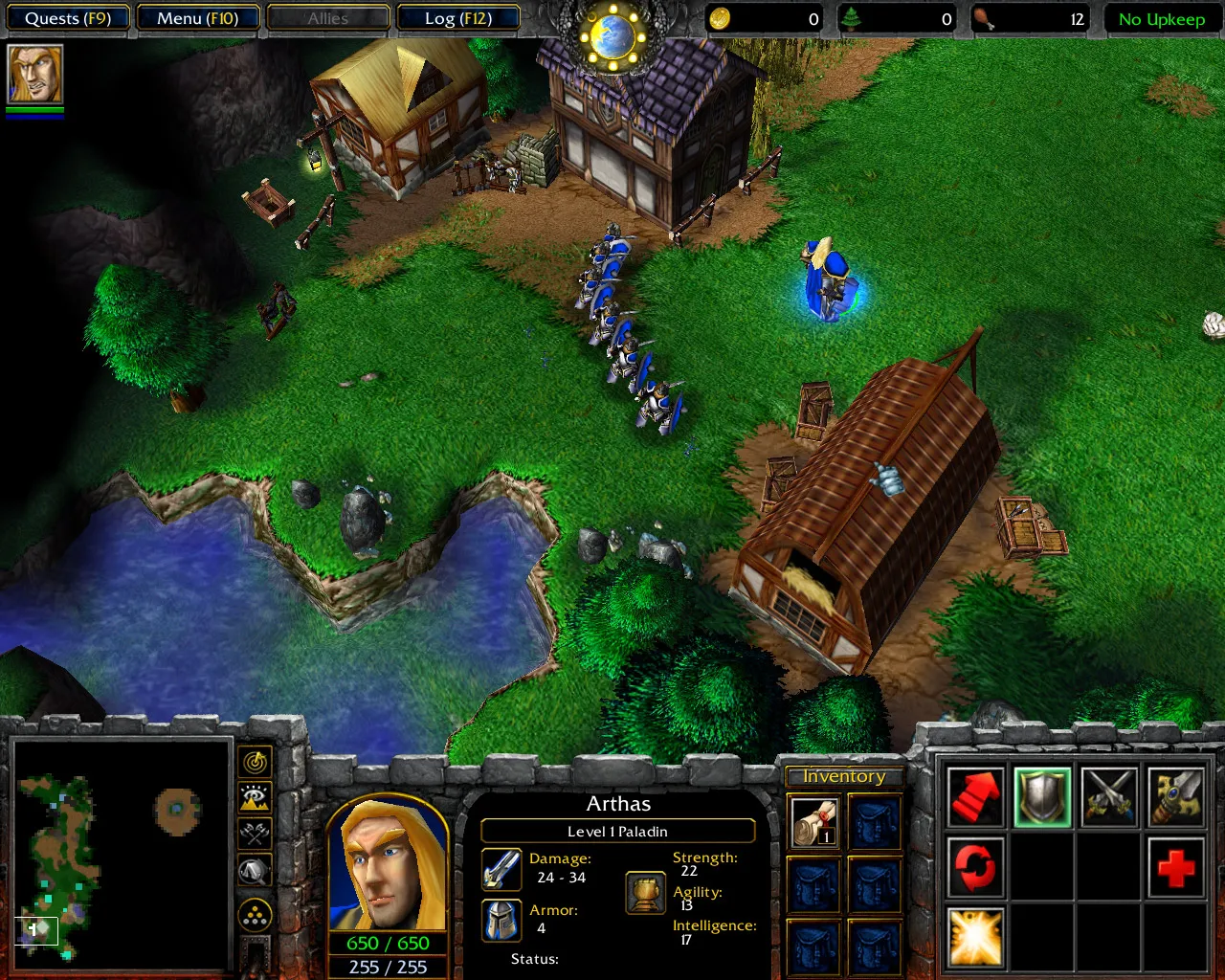
Coming from Age of Empires I and II (AoE) and StarCraft, I ran a big part of Warcraft III on System 1 from the first match. Dragging a box to select a group and right-clicking to move or attack worked like in every RTS I knew. The HUD kept the genre’s layout, and unit voices and alerts needed no thought.
Three things needed System 2. The first was the 12-unit selection limit, when AoE II let me select 40: the first time a box left part of my army behind, I had to stop and work out why. I covered this in the first part. The second was the hero, a unit with health, mana, a level, abilities and items, which AoE never had. The third was new shortcuts. Using the ones I knew by heart was System 1; learning new ones was System 2.
Learning shortcuts is a known problem outside games. Lane and colleagues (2005) found that most of 251 experienced Microsoft Word users preferred toolbar icons over keyboard shortcuts, even though shortcuts were faster. Cockburn and colleagues (2014) explain why: switching to a faster method causes a temporary “performance dip” that can keep people from ever switching. In an RTS, the investment pays off. In a study of 3,360 StarCraft II players, Thompson and colleagues (2013) found hotkey use among the strongest predictors separating professionals from Diamond league players, and read it as a sign of automaticity. Once the controls run on System 1, attention is free for the strategy.
Practice before pressure
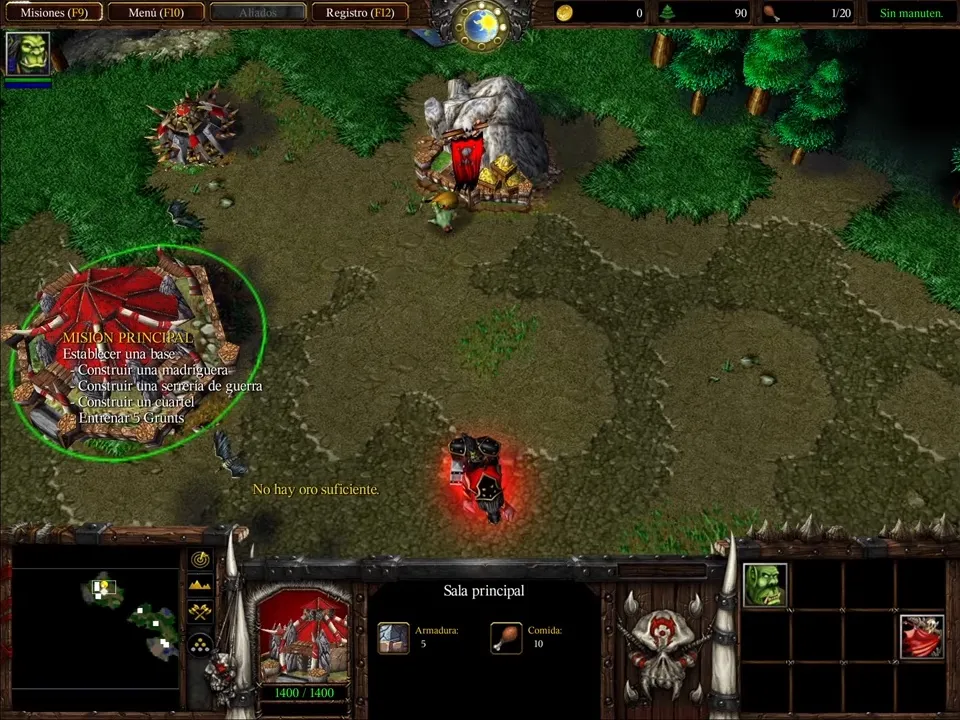
Warcraft III gave players time to build those automatic responses. Its optional prologue, Exodus of the Horde, “walks you through every basic aspect of gameplay in the context of a couple of story-driven missions,” as GameSpot put it in 2002. In the first mission you control only Thrall and a few grunts, with no base or resources. Building and gathering arrive in the second. On Normal, the lowest difficulty you could pick at the start, there was room to try, fail and try again, and losing a mission unlocked an Easy setting. The load grew one layer at a time, which matched what a new player’s brain was ready for.
The mismatch shows up when players skip the prologue. In an easy 1v1 match, the hero, the selection limit, the shortcuts and the base all arrive at once. Winning will probably be stressful, and you probably won’t make good use of your hero.
Attention, memory and learning
Attention
Hodent writes in The Gamer’s Brain that “attentional resources are extremely scarce,” and that when we focus on a task, “we can be completely blind to unexpected events happening right in front of us.” An online match, or a LAN game at the cyber, pushed attention to its limit: base, army and hero at once, against another person. That overload was part of the appeal.
But the campaigns and 1v1 matches against the computer had already taught me the opening routine, done as fast as possible: gather resources, get a hero, level him up, build an army and upgrade the base. Once it was automatic, it stopped competing for attention. The game also helped where it mattered most: the hero’s portrait flashes red when he takes damage, so I knew he was in trouble without looking for him.
Memory
Hermann Ebbinghaus showed in 1885 that we forget fastest right after we learn something, and research on the spacing effect (Cepeda and colleagues, 2006) shows that practice spread over time makes learning last. Hodent turns this into advice for games: “Distribute learning over time (spacing effect). Repeat information. Give reminders.”
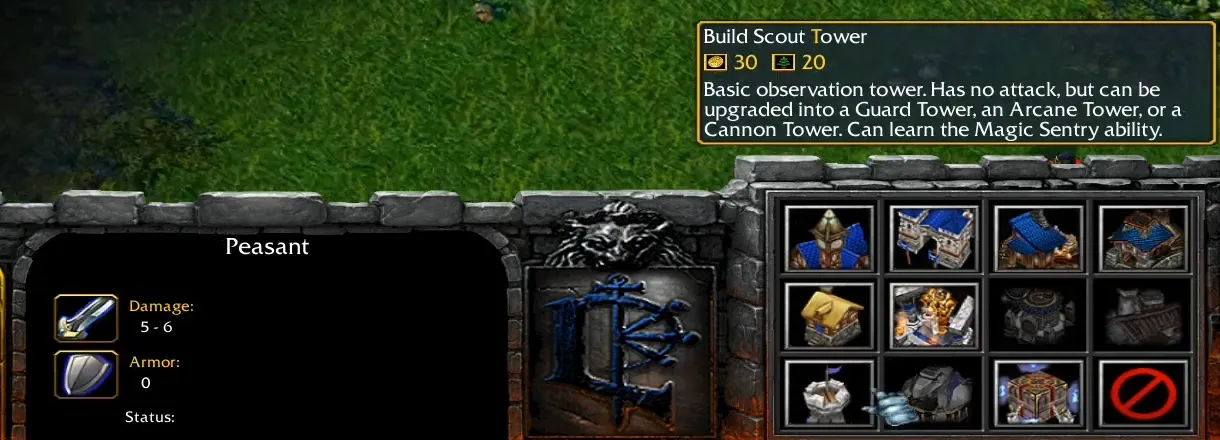
Shortcuts relied on that. Each command’s tooltip showed its hotkey as a yellow letter, a reminder every time I hovered over it, but repeating it until it stuck was up to me.
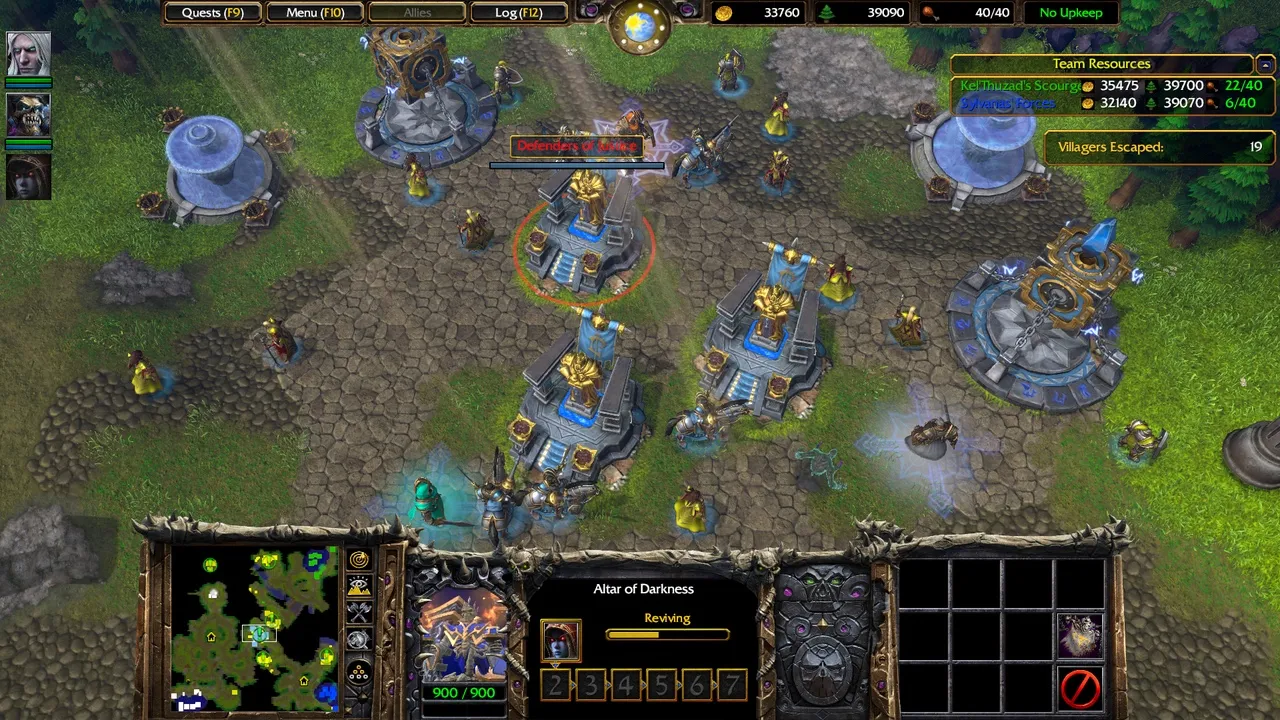
Reviving a hero didn’t rely on memory. The altar shows a button for that hero, with his name, level, type and revival cost, so you don’t have to remember who died. Jakob Nielsen calls this recognition rather than recall. The cost carries a message too: reviving a low-level hero costs less than hiring a new one, but reviving a level 10 hero costs much more (Blizzard, 2002). The stronger the hero, the more there is to lose.
Learning
In the campaigns, the pressure grows mission by mission, so players practice before the hard moments. In a match, the difficulty depends on your opponent.
Mental models and familiar patterns
Players build a mental model of how a game works, and Hodent notes that consistency among games “facilitates the onboarding for players who are familiar with certain game conventions.” Warcraft III kept the RTS conventions: point and click, and a HUD for the base, the army and the resources.
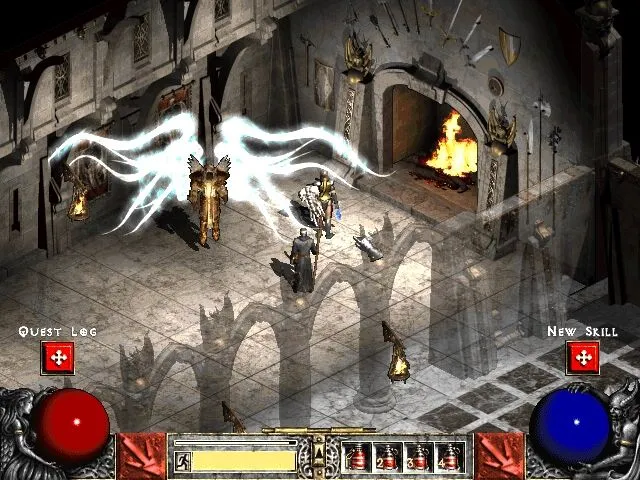
For the hero, it used patterns I knew from Diablo II, and Blizzard has said so. Before launch, the official Warcraft III FAQ described spending a hero’s ability points as “a simplified version of how Diablo II characters work.” In 2020, Blizzard named Warcraft III’s random item drops and its heroes “who had experience levels and skill points to be distributed” among the Diablo II ideas that reached other Blizzard games. My hero earned experience, got a point for an ability at each level and picked up items that monsters dropped, so I didn’t have to learn any of it from scratch.
Most of the game matched what I knew. One rule didn’t: not every unit can attack flying units. Footmen, grunts, ghouls and huntresses only hit ground units, while riflemen, headhunters and archers hit both. AoE II had no flying units, so as an AoE player I had to build that model, often by losing. A StarCraft player already had it, since zealots and zerglings couldn’t attack air either.
Revisiting what I would improve
My recommendation from the first part still holds: keep the 12-unit limit, and the first time a box selection goes over 12 units, show a hint pointing to control groups. I believe it would have been better for players to learn, through a message, a rule they otherwise had to discover by failing.
This analysis adds three gaps, each with a fix based on how players think.
Shortcuts are learned alone. The tooltips show them, but the prologue only mentions a few keys (A to attack, the arrows to scroll, the spacebar to jump to a finished task and Tab to switch subgroups). It never mentions control groups or the keys that select heroes; the game left those to the manual and Blizzard’s website. My fix: when a player clicks the same command button several times, the game says its hotkey out loud. In a software experiment, Grossman and colleagues (2007) spoke the command and its hotkey each time someone used the menu, and hotkey use rose from 28.9% to 66.6%. They chose sound because “the visual channel is often already saturated,” which is even more true in an RTS.
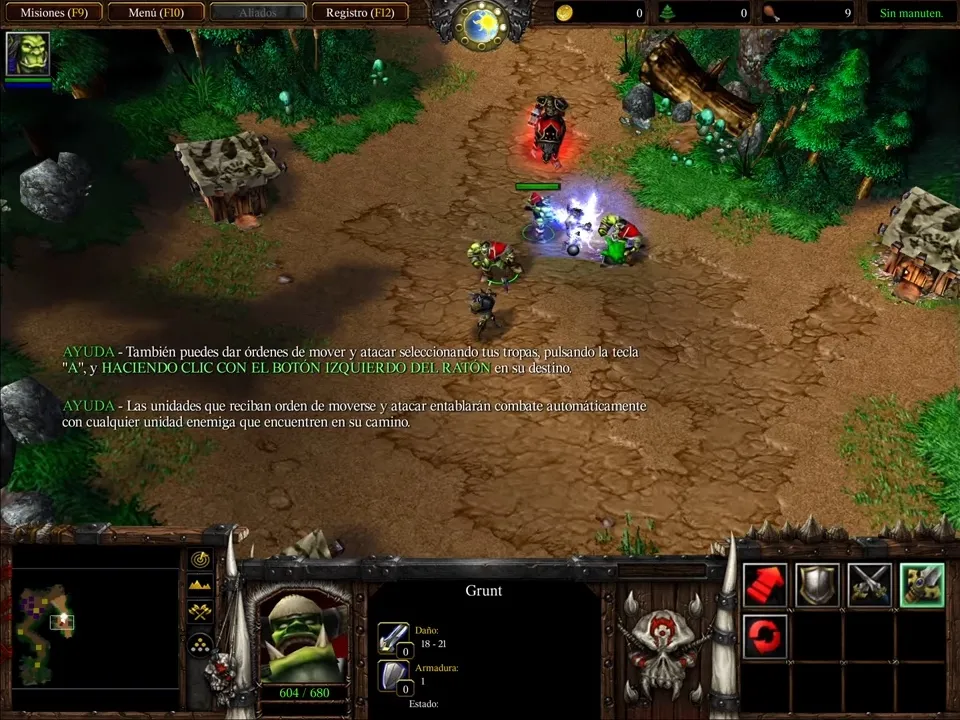
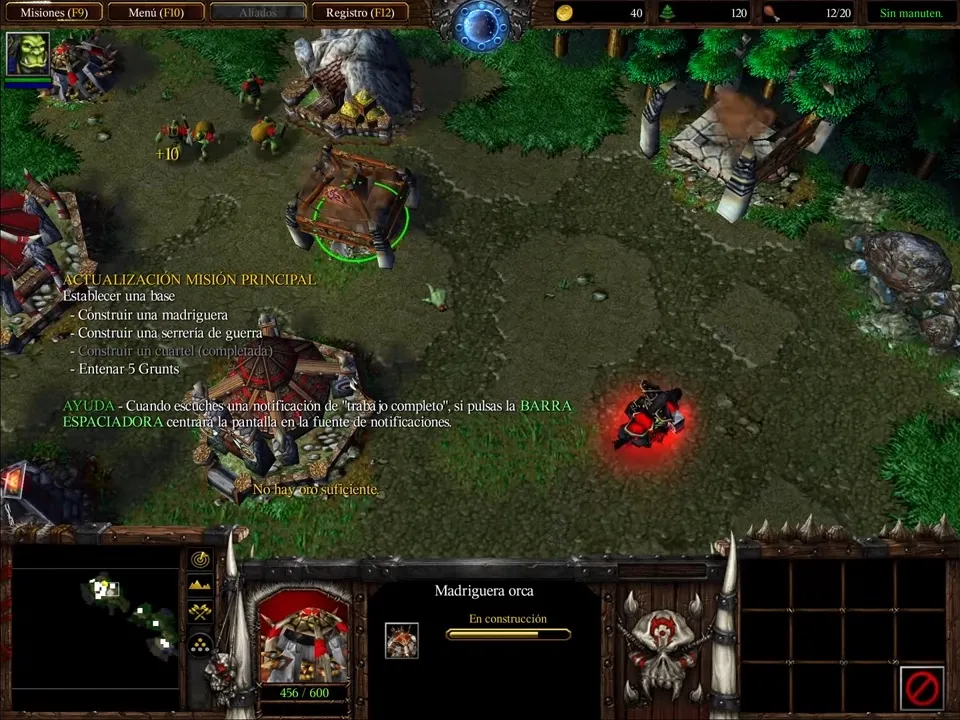
Players who skip the prologue miss the basics. Instead of a tutorial before the match, the game would teach each basic the first time it comes up: experience, the selection limit, control groups and the hero keys. Hero death is a good example. The prologue teaches revival with a hint in its second mission, so players who skip it never see one. In my redesign, the first time a hero dies, I’d show an interactive message: “Your hero has fallen. Go to the altar and revive him.” Clicking it would take the player straight there. Hodent argues it’s more efficient to place players “in a situation where they need and are motivated to learn the new behavior” than to freeze the game and display a tutorial text, and spreading the hints across matches adds the spacing effect. Players could skip the hints and read them again in the message log the game already had.
Flying units catch players off guard. The prologue doesn’t teach this rule, and the campaigns only bring it up in story dialogue, in the Undead and Orc campaigns. Here I’d prevent the error before correcting it, as Hodent’s error prevention pillar suggests. If a player’s army grows without a single unit that can attack air, the game warns them. If an air attack still comes and the selected units can’t hit back, a hint names the units that can.
None of this removes the challenge. Hodent’s minimum workload pillar applies to load that is “not part of the challenge of the game itself,” and in a competitive RTS, speed with the controls is part of it. The goal isn’t to make shortcuts unnecessary but to make them learnable.
What analyzing the game from a cognitive perspective taught me
The first part showed me what worked in Warcraft III; this one showed me why. For an RTS player, most of the game ran on System 1, and the new parts arrived one at a time in a calm prologue. The problems start where that structure ends: when a player skips it, or when a rule like the selection limit or anti-air has to be discovered by losing.
Have you ever known a shortcut would make you faster, but kept clicking because learning it mid-match felt too slow? I’d like to know.
You can keep reading another analysis of the game in part 3, focused on a single moment: reviving a hero mid-fight.
Sources
- Kahneman, D. (2011). Thinking, Fast and Slow. Farrar, Straus and Giroux.
- Hodent, C. (2017). The Gamer’s Brain: How Neuroscience and UX Can Impact Video Game Design. CRC Press.
- Lane, D. M., Napier, H. A., Peres, S. C., and Sándor, A. (2005). Hidden costs of graphical user interfaces: Failure to make the transition from menus and icon toolbars to keyboard shortcuts. International Journal of Human-Computer Interaction.
- Cockburn, A., Gutwin, C., Scarr, J., and Malacria, S. (2014). Supporting novice to expert transitions in user interfaces. ACM Computing Surveys.
- Thompson, J. J., Blair, M. R., Chen, L., and Henrey, A. J. (2013). Video game telemetry as a critical tool in the study of complex skill learning. PLOS ONE.
- Grossman, T., Dragicevic, P., and Balakrishnan, R. (2007). Strategies for accelerating on-line learning of hotkeys. CHI 2007.
Warcraft III and Diablo II screenshots and art © Blizzard Entertainment, shown here for analysis.